
Rodents Age Calculator
Enter your rodent's age to estimate its life stage and approximate human-age equivalent.
Rodents may be small pets, but their aging patterns can be surprisingly different. A hamster, rat, mouse, guinea pig, gerbil, and chinchilla can all have very different lifespans and life stages. Our Rodents Age Calculator helps you estimate your pet’s life stage and approximate human-age equivalent based on its species and current age.
To learn more about your small pet, you can also discover more useful calculators for everyday pet care on our homepage.
🐭 What Is a Rodent’s Age Calculator?
A Rodent Age Calculator is a simple tool that helps estimate where your rodent is in its life cycle.
Instead of using one conversion for every animal, the calculator considers the selected rodent species. This is important because a hamster may live only a few years, while a chinchilla can live considerably longer.
The human-age result is best viewed as an educational comparison, not an exact biological conversion.
Check: Parrot Age Calculator & Ferret Age Calculator
🧮 How to Use the Rodent Age Calculator
Using the calculator takes only a few seconds:
- Select your rodent type.
- Enter your pet’s current age.
- Choose months or years.
- Click Calculate Age.
- View the estimated human-age equivalent and life stage.
For young rodents, entering age in months can provide a more useful estimate.
📊 Rodent Age & Lifespan Comparison
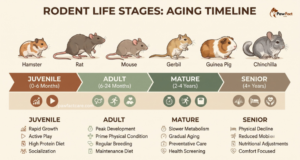
| Rodent | General Lifespan Pattern | Aging Pattern |
|---|---|---|
| 🐹 Hamster | Short | Ages relatively quickly |
| 🐀 Rat | Short | Rapid development and aging |
| 🐁 Mouse | Short | Reaches adulthood quickly |
| 🐹 Gerbil | Short to moderate | Fast early development |
| 🐹 Guinea Pig | Moderate | Slower aging than rats and hamsters |
| 🐭 Chinchilla | Much longer | Ages more gradually |
These are general comparisons. Individual lifespan can vary depending on genetics, species or breed, nutrition, housing, health, and veterinary care.
Also check: Guinea Pig Age Calculator & Rabbit Age Calculator
🐹 Why Do Different Rodents Age Differently?
Rodents do not all age at the same rate. Species is one of the biggest factors, but genetics, diet, environment, and health also contribute.
For example, comparing a one-year-old hamster directly with a one-year-old chinchilla would be misleading because they are at very different points in their expected life cycles.
That is why selecting the correct species makes an age calculator more meaningful.
❓ Frequently Asked Questions
1. How do I calculate my rodent’s age in human years?
There is no single scientifically exact conversion. The calculator provides an approximate comparison based on the selected species and its general lifespan.
2. Is one rodent year equal to several human years?
Not consistently. Rodent species develop and age at different rates, so a fixed conversion such as “one rodent year equals X human years” can be misleading.
3. Which rodents can I use this calculator for?
The calculator supports hamsters, rats, mice, gerbils, guinea pigs, and chinchillas.
4. Should I enter my rodent’s age in months or years?
Either can be used. Months are particularly useful for younger pets because many small rodents mature relatively quickly.
5. How accurate is a rodent age calculator?
It provides an estimate rather than an exact biological age. Genetics, health, diet, environment, and individual variation can all influence how an animal ages.
🏁 Final Thoughts
The Rodent Age Calculator offers a simple way to estimate your hamster, rat, mouse, gerbil, guinea pig, or chinchilla’s life stage and approximate human-age equivalent.
Use the result as a general educational reference rather than an exact measurement. Paying attention to your rodent’s individual health, behavior, weight, appetite, and activity is ultimately more useful than relying on age alone.