
Equine Color Calculator
Estimate possible foal coat colors based on the sire's and dam's coat-color genetics.
Choose the known or suspected genetic traits of both parents. The calculator estimates basic foal coat-color probabilities using Extension, Agouti, and Cream genes.
| Coat Color | Probability |
|---|
Have you ever wondered what color your foal will be before it’s born? Whether you’re breeding two chestnut horses, a bay and a black horse, or horses carrying cream dilution genes, predicting a foal’s coat color can be exciting. However, horse coat colors aren’t determined by appearance alone. They depend on the genetic traits inherited from both parents. Our Equine Color Calculator helps estimate possible foal coat colors, genetic combinations, and inheritance probabilities using the sire’s and dam’s coat-color genetics.
Whether you’re a horse owner, breeder, or simply curious about equine genetics, this calculator makes basic coat-color inheritance easier to understand. You can also explore more helpful animal-care calculators on Paw Fact Care for practical pet and animal-care information.
🎨 What Is an Equine Color Calculator?
An Equine Color Calculator is an online tool that estimates the possible coat colors of a foal based on genetic information from its parents.
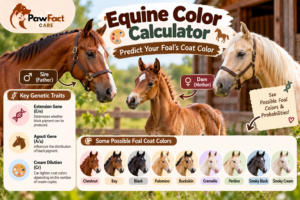
Horse coat colors are influenced by several genes. This calculator focuses on three important genetic systems:
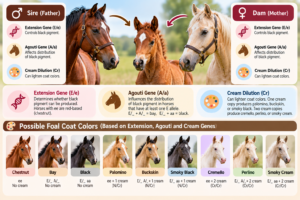
- Extension Gene (E/e): Determines whether a horse can produce black pigment.
- Agouti Gene (A/a): Influences the distribution of black pigment.
- Cream Dilution Gene (Cr): Lightens certain coat colors depending on the number of cream copies inherited.
By combining these genetic traits from the sire and dam, the calculator estimates the probability of different foal coat colors.
The results are based on simplified Mendelian inheritance and should not be considered guaranteed predictions.
Check: Mini Bernedoodle Weight Calculator & Reef Tank Calculator
📏 How to Use the Equine Color Calculator
1. Enter the Sire’s Extension Gene
Start by selecting the father horse’s Extension genotype.
Choose EE, Ee, or ee according to the available genetic information.
The Extension gene determines whether a horse can produce black pigment or has a red-based coat.
2. Select the Sire’s Agouti Gene
Choose the sire’s Agouti genotype: AA, Aa, or aa.
This gene affects the distribution of black pigment in horses that have at least one functional Extension allele.
3. Choose the Sire’s Cream Dilution
Select whether the sire has no cream copies (N/N), one cream copy (N/Cr), or two cream copies (Cr/Cr).
Cream dilution can produce colors such as palomino, buckskin, cremello, and perlino.
4. Enter the Dam’s Genetics
Repeat the same process for the mother horse.
Select her Extension, Agouti, and Cream genotypes using known genetic test results whenever possible.
5. Calculate Foal Color Probabilities
Click Calculate Foal Color Probabilities to view the possible coat colors and their estimated percentages. The calculator also displays a visual probability chart and genetic inheritance breakdown.
Note: Exact probabilities require known genotypes for all three modeled genes in both parents. If any genotype is unknown, the calculator asks for additional information rather than inventing genetic probabilities.
📊 Equine Color Calculator Results Explained
| Calculator Result | What It Shows |
|---|---|
| Most Likely Color | Coat color with the highest calculated probability |
| Color Probability Chart | Visual comparison of possible foal colors |
| Possible Foal Colors | List of colors produced by the genetic combinations |
| Red-Based Probability | Chance of inheriting the ee genotype |
| Black-Pigment Probability | Chance of inheriting at least one E allele |
| No Cream Copies | Probability of inheriting N/N |
| One Cream Copy | Probability of inheriting N/Cr |
| Two Cream Copies | Probability of inheriting Cr/Cr |
Each percentage represents the probability for an individual foal under the calculator’s simplified genetic model.
For example, a 50% probability does not mean that exactly half of the foals from a particular pair of horses will have that color.
Also check: Cat Weight Loss Calculator & Cat Due Date Calculator
❓Frequently Asked Questions
1. How can I predict my foal’s coat color?
You can estimate possible foal colors by entering the sire’s and dam’s genetic information into an Equine Color Calculator. The tool combines their Extension, Agouti, and Cream genotypes to calculate possible outcomes. DNA testing can improve accuracy when the parents’ genotypes are uncertain.
2. What color will a foal be from a black and chestnut horse?
The result depends on the black horse’s Extension genotype and both parents’ Agouti genotypes. A black horse carrying e may produce red-based offspring when bred to a chestnut horse, while an EE black horse cannot produce an ee foal with a chestnut parent.
3. Can two bay horses produce a chestnut foal?
Yes, if both bay parents carry the recessive e allele. When two Ee horses are bred, there is a 25% probability of an ee foal. Additional genes may affect the foal’s visible color.
4. Is horse coat color inherited from the mother or father?
Horse coat color is influenced by genetic material inherited from both parents. Each parent contributes alleles that can affect the foal’s base coat color and dilution. The resulting combination determines which modeled traits may be expressed.
5. Is the Equine Color Calculator 100% accurate?
No. The calculator provides theoretical probabilities based on three genetic loci and assumes standard inheritance. It does not include all genes influencing horse coat color, and the results depend on entering accurate parental genotypes. It cannot guarantee the color of an individual foal.
🏁 Final Thoughts
The Equine Color Calculator makes it easier to explore horse coat color genetics, possible foal colors, and inheritance probabilities using information from the sire and dam.
By understanding the Extension, Agouti, and Cream genes, horse owners and breeders can learn why colors such as chestnut, bay, black, palomino, buckskin, cremello, and perlino occur.
Remember that coat-color genetics are more complex than any three-gene model. Use the calculator as an educational planning tool, and consider genetic testing when more precise information is important.