
Reef Tank Calculator
Calculate your reef aquarium's water volume, estimated actual water capacity, salt mix, water changes, and recommended flow rates.
—
Setting up a reef aquarium is exciting, but getting the water volume, salt mix, and circulation right can feel confusing, especially if you’re new to saltwater aquariums. A reef tank contains more than just water. Live rock, sand, corals, equipment, and even the sump can affect how much water your aquarium actually holds. Our Reef Tank Calculator helps estimate your reef tank water volume, salt mix requirements, water change amount, and aquarium circulation rate using a few simple measurements.
Whether you’re planning your first saltwater aquarium or maintaining an established reef, understanding these numbers can make routine care easier. You can also explore more helpful pet care calculators on Paw Fact Care for aquarium planning and everyday animal-care guidance.
🪸 What Is a Reef Tank Calculator?
A Reef Tank Calculator is an online tool that helps aquarium owners estimate the water capacity and basic maintenance requirements of a reef aquarium.
Unlike a basic aquarium volume calculator, this tool considers the space occupied by rocks and sand, the actual water fill level, and any additional water stored in a sump.
It can help you estimate:
- Total reef tank water volume in US gallons and liters
- Actual display tank water after displacement
- Sump water capacity
- Salt mix required for preparing new saltwater
- Water needed for routine water changes
- Approximate aquarium circulation rates
These estimates are useful for planning a new reef setup and understanding the water volume of an existing aquarium.
Check: Aquarium Fish Stocking Calculator & Aquarium Water Change Calculator
📏 How to Use the Reef Tank Calculator
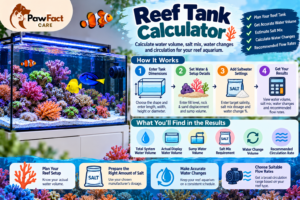
1. Select Your Aquarium Shape
Start by choosing your aquarium’s shape. The calculator supports rectangular, cube, and cylindrical reef tanks.
Different shapes require different volume calculations, so selecting the correct shape is important.
2. Enter Your Tank Dimensions
Enter the aquarium’s length, width, height, or diameter, depending on the selected shape.
You can use inches or centimeters. For the most accurate result, measure the inside dimensions of your aquarium rather than relying only on its advertised capacity.
3. Adjust the Water Fill Level
Enter the percentage of the aquarium’s height that is filled with water.
For example, a 95% fill level means the water reaches approximately 95% of the tank’s internal height.
4. Estimate Rock and Sand Displacement
Live rock, sand, and other objects occupy space that would otherwise contain water.
Enter an estimated rock and sand displacement percentage to account for this difference. The actual amount depends on your aquascape and materials.
5. Add Sump Water Volume
If your reef aquarium uses a sump, enter its actual operating water volume in gallons or liters.
Do not enter the sump’s full advertised capacity unless it normally operates completely filled.
6. Enter Saltwater Settings
Choose your target salinity, enter the salt manufacturer’s recommended mixing dosage, and select your preferred water change percentage.
Finally, choose your reef type and click Calculate Reef Tank Requirements to see the results.
📊 Reef Tank Calculator Results Explained
| Calculator Result | What It Shows |
|---|---|
| Full Tank Capacity | Water capacity before accounting for fill level and displacement |
| Filled Display Volume | Water volume at the selected fill level |
| Actual Display Water | Estimated water after rock and sand displacement |
| Sump Water | Additional water in the sump |
| Total System Volume | Estimated display water plus sump water |
| Salt Mix Required | Approximate salt needed to prepare the calculated volume of new saltwater |
| Water Change Volume | Amount of water to replace at the selected percentage |
| Circulation Range | Broad suggested in-tank water movement range |
The calculator also displays a visual breakdown of display tank water versus sump water, making it easier to understand how water is distributed throughout your system.
Also check: Fish Age Calculator & Aquarium Volume Calculator
❓ Frequently Asked Questions
1. How do I calculate reef tank water volume?
Measure the aquarium’s internal dimensions and calculate the volume according to its shape. Then account for the water fill level, displacement from rocks and sand, and any additional water in the sump. The Reef Tank Calculator performs these steps automatically.
2. How much salt do I need for a 50-gallon reef tank?
The amount depends on the salt mix manufacturer’s recommended dosage and your target salinity. For example, 50 US gallons is approximately 189 liters, so a dosage of 37 g/L would require roughly 7 kg of mix to prepare that volume of new saltwater. Always verify the final salinity before use.
3. Does live rock reduce aquarium water volume?
Yes. Live rock occupies space inside the aquarium, reducing the amount of water it can contain. However, rock porosity and arrangement make the actual displacement difficult to predict precisely, so the calculator uses an estimated percentage.
4. How much water should I change in a reef tank?
There is no single water change percentage suitable for every reef aquarium. Some aquarists use regular partial water changes, but the appropriate schedule depends on water quality, nutrient management, livestock, and maintenance practices.
5. What is a good flow rate for a reef tank?
The appropriate flow depends on the coral species, tank dimensions, pump arrangement, and aquascape. Soft corals, LPS corals, and SPS corals may have different circulation preferences. Broad turnover ranges can help with initial planning, but actual flow should be adjusted based on the needs and response of the livestock.
🏁 Final Thoughts
The Reef Tank Calculator helps simplify some of the most important calculations involved in planning and maintaining a saltwater aquarium. From estimating actual reef tank water volume to calculating salt mix, water changes, and circulation, it provides useful starting points for everyday aquarium management.
Remember that calculated values are estimates. Actual aquarium conditions should always be verified with reliable measurements, appropriate testing equipment, and the requirements of the fish, corals, and other animals in your reef system.