
How Big Will My Cat Get?
Estimate your kitten's full adult weight and size category based on veterinary growth curve milestones.
A How Big Will My Cat Get Calculator is an educational tool that helps cat owners estimate how large a kitten may become when it reaches adulthood. It can use information such as current age, current weight, sex, and breed to provide an approximate adult size.
For more useful ways to understand your pet’s growth and everyday needs, explore our practical pet-care calculators and tools.
Kittens grow at different rates, and their final size can be influenced by genetics, breed, nutrition, health, and individual development. Because of this, a calculator can provide a useful estimate, but it cannot predict your cat’s exact adult weight or size.

🧮 How to Use the Cat Size Calculator
Enter the information requested by the calculator:
- Kitten’s Current Age – Enter your kitten’s age in weeks or months.
- Current Weight – Enter the kitten’s present weight.
- Sex – Select male or female if requested.
- Breed – Choose the breed or closest option when available.
The calculator then provides an estimated adult weight or size range based on the information entered.
Check: Cephalexin for Cats Dosage Calculator & Cat Chocolate Toxicity Calculator
📈 How Do Kittens Grow?
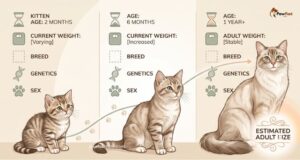
Cats experience their fastest growth during kittenhood. Their growth rate gradually slows as they approach adulthood.
Many cats reach most of their adult size during the first year, while some larger breeds continue growing for considerably longer. A kitten’s paws, body shape, muscle development, and overall proportions can also change as it matures.
💡 Can You Predict a Cat’s Exact Adult Weight?
Not perfectly. A cat growth calculator provides an estimate rather than a guarantee.
Genetics, nutrition, health, and individual growth patterns can all influence the final result. If your kitten’s growth seems unusually slow or fast, a veterinarian can evaluate whether development is progressing normally.
Also check: Cat Food Calculator & How Much Wet Food to Feed a Cat Calculator
📊 What Affects a Cat’s Adult Size?
| 🐱 Factor | How It Can Affect Growth |
|---|---|
| Breed | Some breeds naturally grow much larger |
| Genetics | Parents can strongly influence adult size |
| Age | Growth rate changes as kittens mature |
| Current weight | Provides a useful indicator of growth |
| Sex | Adult size can differ between males and females |
| Nutrition | Balanced nutrition supports normal development |
| Health | Illness can affect growth and development |
These factors explain why two kittens of the same age may eventually reach very different adult sizes.
❓ Frequently Asked Questions
1. How accurate is the How Big Will My Cat Get Calculator?
It provides an estimate based on the information entered. Actual adult size can vary because genetics, breed, nutrition, and health all influence growth.
2. At what age do cats stop growing?
Many cats reach most of their adult size during the first year, but some cats—particularly larger breeds—may continue developing for longer.
3. Does a kitten’s current weight predict adult weight?
Current weight can provide a useful indication of growth, but it cannot guarantee an exact adult weight.
4. Do male cats grow bigger than female cats?
On average, males of many breeds tend to be somewhat larger, but individual cats can vary considerably.
5. Can I use this calculator for a mixed-breed kitten?
Yes. You can use the calculator for an estimate, but mixed-breed cats can be more difficult to predict because their genetic background may be varied.
🏁 Conclusion
The How Big Will My Cat Get Calculator gives cat owners a convenient way to estimate their kitten’s potential adult size using factors such as age, current weight, sex, and breed.
Remember that every cat develops differently. Use the calculator as a helpful growth reference, while relying on regular veterinary care to monitor your kitten’s actual development.