Cow Age Calculator – Estimate Cow Age in Human Years

🐄

Cow Age Calculator

Enter your cow's age to estimate its life stage and approximate human-age equivalent.

Estimated Cow Age
🐄
Approximate Human-Age Equivalent — human years*
Cow Age —
Life Stage —
Cow Life Stage
Calf
Young
Adult
Mature
Senior

💡 Cow Care Tip: Age is only one part of cattle management. Nutrition, breed, production status, body condition, dental health, environment, and overall health should also be considered.
*The human-age equivalent is an approximate educational comparison, not an exact biological conversion.
Understanding a cow’s age can be useful for monitoring growth, nutrition, and general care throughout different stages of life. A young calf has very different needs from an adult or older cow. Our Cow Age Calculator helps estimate your cow’s approximate human-age equivalent and identifies its general life stage.

For more helpful tools related to animals and livestock, explore our collection of practical animal care calculators on the homepage.

Cow Age Calculator – Estimate Cow Age in Human Years

🧮 What Is a Cow Age Calculator?

A Cow Age Calculator is a simple tool that uses your cow’s current age to provide an approximate human-age comparison.

Enter the age in months or years, and the calculator will show:

  • Cow’s current age
  • Approximate human-age equivalent
  • Estimated life stage
  • Age-related care information

The human-age result is only an educational estimate because cows and humans develop and age differently.

Check: Cow Gestation Calculator & Cattle Per Acre Calculator

🐄 How to Use the Cow Age Calculator

Using the calculator is simple:

  1. Enter your cow’s current age.
  2. Select months or years.
  3. Click Calculate Cow Age.
  4. View the estimated human-age equivalent.
  5. Check the cow’s general life stage.

For calves under one year old, entering the age in months can make the result easier to understand.

Cow Life Stages – From Calf to Senior Cow

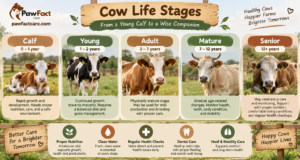
📊 Cow Life Stages at a Glance

Life Stage General Age Range* What to Expect
🍼 Calf Under 1 year Rapid growth and development
🌱 Young 1–2 years Continued growth toward maturity
🐄 Adult 2–7 years Mature adult stage
🌾 Mature 7–12 years Gradual age-related changes
❤️ Senior 12+ years May require closer monitoring

*These ranges are broad educational categories. Actual development and aging vary according to breed, sex, health, nutrition, and management.

Also check: Rat Cage Calculator & Animal Mortality Rate Calculator

⏳ How Long Do Cows Live?

A cow’s potential lifespan is influenced by many factors, including breed, genetics, nutrition, health, environment, and management.

The length of time cattle remain in a particular herd or production system is not necessarily the same as their biological lifespan. This is why chronological age should be considered alongside the individual animal’s health and condition.

❓ Frequently Asked Questions

1. How old is my cow in human years?

There is no exact scientific conversion between cow years and human years. The calculator provides an approximate comparison to make the cow’s stage of life easier to visualize.

2. How do I calculate my cow’s age?

Enter the cow’s known age in months or years into the Cow Age Calculator. It will display the age along with an estimated life stage and human-age comparison.

3. At what age is a cow considered an adult?

There is no single age that applies perfectly to every animal. Breed, sex, physical development, and production system can influence when cattle are considered mature.

4. Can you tell a cow’s age by its teeth?

Teeth can help estimate cattle age when accurate records are unavailable. However, dental wear varies, so it should be treated as an estimate rather than an exact birth date.

5. Is the cow-to-human age conversion accurate?

It is an educational estimate only. Cattle and humans have very different growth and aging patterns, so there is no universally accepted exact conversion.

🏁 Final Thoughts

The Cow Age Calculator provides an easy way to estimate a cow’s life stage and view an approximate human-age equivalent.

Use the result as a general reference rather than an exact measure of biological aging. Breed, nutrition, health, environment, body condition, and individual development are all important when evaluating the needs of cattle at different ages.

Comments

No comments yet. Why don’t you start the discussion?

Leave a Reply

Your email address will not be published. Required fields are marked *